Andy Warhol Pre-Pop
by Gary Comenas
page two
323 W. 21ST ST: FRANZISKA BOAS
When Andy Warhol and Philip Pearlstein's sublease was up, they found another apartment through the New York Times classifieds - a large second floor room at 323 W. 21st Street which they rented from the dancer Franziska Marie Boas who shared the space with her friend Jan Gay and their large sheepdog named "Name."(1) Boas was the daughter of the Prussian-born anthropologist, Franz Boas, who was the first professor of anthropology at Columbia University - a position he held for 37 years. In 1927 he had written a book, Primitive Art, which proposed a theory of dance as an emotional outlet and challenged the racial bias of the then prevalent theories of physical anthropology.(2) His daughter, Franziska, also challenged racial bias by organizing multi-racial dance groups and classes. From 1933 to 1950 she ran the Boas School of Dance, with sessions held at the 21st Street apartment. She had divided the large room with a proscenium arch with Warhol and Pearlstein on one side of the arch and her dance classes on the other side. She was particularly keen on improvisational dance and sometimes invited artists to sketch the dancers while they improvised although it is not known whether Warhol participated in any of these sessions.
In April 1950 Boas was evicted from the commercially zoned property and Warhol and Pearlstein were, again, forced to move. They went their separate ways. In August 1950, Pearlstein married an ex-classmate from Carnegie Tech, Dorothy Cantor, and Warhol was part of the wedding party. One of the first places that Philip and Dorothy lived in was an apartment they got from the artist Lester Johnson on East 4th Street between Avenues A and B.(3) Pearlstein returned to school, studying for a Master of Arts degree at New York University's Institute of Fine Arts with a thesis on the Dada artists, Francis Picabia and Marcel Duchamp.(4) By the time of Pearlstein's wedding Warhol was living at 74 West 103rd Street.
Warhol shared the 103rd Street apartment with other classmates from Carnegie Tech. including Ellie Simon and Leila Davis. Although Ellie soon returned to Pittsburgh, Davis stayed in New York and took some rare photographs of Warhol during his early years. Another flatmate was Elaine Finsilver who had met some of the other people living in the apartment at a ballet class. Finsilver remembered that Warhol "shared his room with Tommy Quinland, and when Jack Hudson came, Jack moved in. And depending on who came last, there were three beds in the room. It was just a large, bare room except for usually three unmade beds, and Andy had his drawing table, I remember, on the left as you walked into the room... [The drawing table] was a nice taboret. It was like an architectural draftsman table, and he had a light over it. And all over it, he had all of his pens, and ink things were all neatly placed, and everything was in its place, and a lot of masking tape, and that's all... I used to got to my dance class. They [the other flatmates] usually never got up until two or three in the afternoon. So, by the time I got back, they were ready to have breakfast, which was, like six o'clock in the evening... Andy was not at that point in his life what one would call a 'hard worker.'(6) Finsilver's characterization of Warhol is the opposite of what Philip Pearlstein remembered when he and Warhol were living together. According to Pearlstein, Warhol was "always a workaholic, obsessive" who worked into the night after Pearlstein had retired to bed.(7)
One of Finsilver's dates, Robert Fleisher, later recalled his own impressions of Warhol and the other people who lived at 103rd Street.
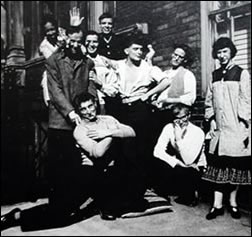
The 103rd Street Gang - New York 1950 Top row (L): Mata (a girlfriend of Victory Reilly's) and Jack Hudson Second Row: Joey Ross, Victor (Buddy) Reilly, Tommy Quinlan, Dale Blosser and Ellie Simon Kneeling front: Jack (Mitch) Beaber and Andy Warhol (Photo: Leila Davies Singeles)
Robert Fleisher:
"The first time that I ever saw Andy... he was working at this little desk doing sketches that he was trying to show to the editor of Park East. But in the room were very large canvases in oils. Serious painting somewhat... in the late thirties there was a newsreel of a bombing in China... and on the railroad track, there was a baby screaming - world famous... Andy did a version of that in pastel oils. It was a very large canvas... I thought it was spectacular, and it was partly line drawing with the blotted-line, but it was pastel oils. Now that's very early, way before he was a successful illustrator. I mean, when he had one pair of pants and [was] living in a cellar at 104th Street [sic] and Manhattan Avenue with six people... I became part of their crowd through Elaine and I saw them quite often..."(8)
Fleisher, as the stationery and gift buyer for Bergdorf Goodman, would later commission Warhol to design stationery for the department store. Henry Kaiser (of Kaiser Aluminium) was so impressed by Warhol's butterfly stationery that he purchased all of the first 60 boxes.(9)
Robert Fleisher:
"I was a buyer at Bergdorf. When I became the stationery buyer, I thought it would be great for Andy to do stuff for us... I had bought the Butterflies from Andy myself for my own personal collection. I think they were 10 dollars. They were among those that I helped hand paint myself. He had a stack of Butterflies this high, and we were all sitting there filling in, and so forth. But, I remember waking up one morning, racking my brain for a stationery design, looking at the wall, and there was this Andy Butterfly thing, and I said, 'Oh, my god!' and called Andy and he said we would love to do it. And we fixed a price, which Bergdorf paid. And we decided that he would do some party invitations and Christmas cards, and so forth, and he got paid and got the cards - a certain amount of stationery cards and invitations that he wanted for his own use. He complained bitterly for weeks afterwards that he had been taken advantage of and that we had to pay him more after he had signed and agreed and everything was fine. He did that over and over and over again - that he was being cheated, that he should have gotten more, that he had done it as a favour, blah-blah-blah."(10)
Another person who shared the apartment was Margery Beddow who, like Victor Reilly and Elaine Finsilver, was a dancer. Reilly and Beddow would appear together in the Broadway musical revue Two on the Aisle, which ran from July 1951 to March 1952. Prior to appearing in that production, Reilly had also appeared in the musical comedy, Where's Charley, at the Broadway Theatre. Beddow, who would later write a book on choreographer Bob Fosse, remembered Warhol sketching his roommates and then surprising them with a gift of the drawings in a loose-leaf notebook.(11)
24TH STREET
According to another ex-student from Carnegie Tech., Joseph Groell, Warhol moved in with him for "a month or two" beginning in November 1950, "until his mother came to New York and he found an apartment, I think in the 70s." According to Groell, "Andy was stuck paying the rent [at 103rd Street] and I think he was the primary tenant. And there were all these bizarre people who came and went and ran up a huge phone bill. And finally Andy, I guess, had too much of it, and couldn't cope with it, and he moved into my place."(12)
Groell's apartment was located at 24th Street between First and Second Avenue. He remembered Warhol adopting a novel approach when phoning art directors for work. Groell heard Warhol begin his telephone conversations with "Hello, I'm just sitting on my bed here, playing with my yo-yo," and joking with potential employers before asking for commissions: "I planted some bird seed in the park yesterday... would you like to order a bird? And do you have any work for me?"(13) By adopting such novel approaches Warhol guaranteed that his name would be remembered by art directors in the highly competitive field of commercial illustration.
1951 - 1952: EAST 75TH STREET
By June 1951, Warhol was living in another apartment registered in Victor Reilly's name at 218 East 75th Street.(14) By 1952, Warhol was living next door at 216 East 75th Street. It was while he was living on 75th Street that his mother, Julia, moved in with him from Pittsburgh. She would continue to live with Warhol until the autumn of 1970 when she returned to Pittsburgh for health reasons.(15) In June 1952 Warhol had his first exhibition in New York at the Hugo Gallery.
Andy Warhol's first pre-Pop exhibition featured a series of drawings inspired by Truman Capote's short stories. Capote's first book, Other Voices, Other Rooms was published in 1948 when Warhol was still at college. Two months prior to Warhol's exhibit at the Hugo, Capote's play, The Grass Harp, had premiered on Broadway at the Martin Beck Theater, with sets and costumes designed by Cecil Beaton.
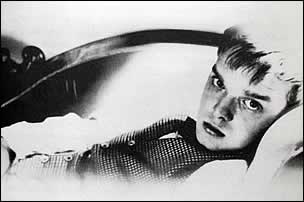
Photograph of Truman Capote used on the book jacket of Other Voices, Other Rooms (Photo: Harold Halma)
Truman Capote:
"When he was a child, Andy Warhol had this obsession about me and used to write me from Pittsburgh... When he came to New York, he used to stand outside my house, just stand out there all day waiting for me to come out. He wanted to become a friend of mine, wanted to speak to me, to talk to me. He nearly drove me crazy."(16)
The photograph of Truman that appeared on the dust jacket for Other Voices Other Rooms showing him seductively staring at the camera with his right hand resting above his groin, generated a considerable amount of controversy when it was published. According to Robert Fleisher Warhol was "madly in love" with Capote and "there was a photograph of Truman Capote on a couch, stretched out in a plaid vest, and that's what sent him [Warhol] off provisionally. As I remember, he had that around all the time and talked about it... it's from the back of Other Voices, Other Rooms..."(16a)
Truman Capote:
"I started writing when I was eight - out of the blue, uninspired by any example. I'd never known anyone who wrote; indeed, I knew few people who read... By the time I was seventeen, I was an accomplished writer... I sent off stories to the principal literary quarterlies, as well as to the national magazines... and stories by me duly appeared in those publications. Then, in 1948, I published a novel: Other Voices, Other Rooms. It was well received critically, and was a best seller. it was also, due to an exotic photograph of the author on the dust jacket, the start of a certain notoriety that has kept close step with me these many years. Indeed, many people attributed the commercial success of the novel to the photograph."(16b)
Warhol and Capote did eventually become friends. In 1973 Rolling Stone magazine commissioned Capote to write an article about the band, The Rolling Stones, and sent him on tour with them. When he came back without having written anything, the magazine asked Warhol to interview Capote about the tour. Warhol was accompanied by Bob Colacello who was, at the time, a contributing editor of Interview magazine. Early in the interview Warhol explains to Colacello that, "I used to write to Truman every day for years until his mother told me to stop it." When Truman says that he doesn't remember his mother doing that, Warhol responds, "She did. She called me up and said it. She was really sweet." Capote then replies, "She was drunk."(17) Later in the interview Capote explains his reaction to Warhol's questioning:
Truman Capote: "You said something to me that really startled me when you came to the house today... You said that my mother telephoned you. I was absolutely startled. Really startled."
Andy Warhol: "You were? Why?"
Truman Capote: "Because my mother really was an alcoholic."
Andy Warhol: "But I met your mother."
Truman Capote: "I know you met my mother. But my mother was a very ill woman, and a total alcoholic... she was an alcoholic when you met her. She had been an alcoholic since I was 16, so she was an alcoholic when you met her... she had this sort of sweet thing, and then suddenly she'd - well you know she committed suicide."
Andy Warhol: "She did? Oh, I didn't know that. I thought she just got sick."
Truman Capote: "No, no, no, no. She committed suicide."(18)
It is interesting to note that neither Andy nor Truman mention meeting each other prior to the death of Capote's mother, Nina, who committed suicide in 1954.(19) In the Rolling Stone interview, Warhol says that he met Capote's mother but does not claim to have met Truman during the same period. Yet several Warhol biographers have maintained that they did meet each other during Warhol's early years in New York.
The exhibition of Warhol's Capote inspired drawings ran at the Hugo Gallery from June 16 - July 3, 1952. The Hugo had been founded in 1944 by Robert Rothschild, Elizabeth Arden and Maria Hugo who was married to author Victor Hugo's grandson. In 1947 the gallery had hosted Bloodflames, a show of Surrealists which included work by Gorky and Matta. At the time of Warhol's show, the director of the gallery was Alexandre Iolas, assisted by David Mann, the gallery's manager. Iolas would also be responsible for Warhol's last exhibition when, in January 1987, he showed Warhol's Last Supper paintings in Milan at the Palazzo delle Stelline, across from the Church of Santa Maria della Grazie which housed Leonardo's Last Supper. Iolas had commissioned Warhol to do his version of Leonardo's painting in early 1986.
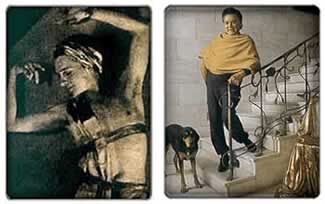
Alexandre Iolas as a dancer in 1929(L) and with his doberman, Frida (R)
Alexandre Iolas (ca. 1984):
"Early on, I did an exhibition of Andy Warhol in my gallery... The boy is a very important artist, Andy, because he helped America. He mixes very much with youth, and with all the chic people - you know, the bums. When you have such a stupid expression as Andy has - when he is being silent, before the smile starts - when you look like that, you can do anything you want in the world. As Christ said to all those priests, 'Suffer the little children to come unto me,' and Warhol is a horrible child. He has helped America to get rid of its puritanism, either with his half-pornographic, half esthetic films or else with his portraits of the fake stars he has around him and the real stars he has always liked. He's an amazing person, and probably someday he will be considered a saint."(35)
Iolas, born in Alexandria, Egypt in 1908, came from a dance background. After studying ballet in Berlin he fled to Paris during Hitler's rise to power in the 1930s. In Paris he continued to study dance and socialized with artists such as Jean Cocteau, Georges Braque, Pablo Picasso, Max Ernst and Man Ray. After moving to New York he was able to draw on these artistic contacts when he quit dancing in order to concentrate on his career as an art dealer. After working at the Hugo gallery, he founded the Jackson-Iolas Gallery in 1955 with former dancer, Brooks Jackson and later opened galleries in Paris, Milan, Madrid and Mexico City. He died of AIDs in June 1987 - just four months after Warhol had died in the same hospital in New York.
At the time of his death, Iolas was embroiled in his own Greek tragedy. Anonis Nikolaou, a transvestite who called himself Maria Kallas, had been employed by Iolas at his home in Greece. In 1985 Iolas fired Kallas for "acute alcoholism, pathological lying," and stealing "small but valuable" objects from Iolas' collection. Kallas fought back. He publicly accused Iolas of "antiquities smuggling, drug peddling, and the prostitution of young men," naming the former president, Konstantine Karamanlis, as a frequent visitor to orgies hosted by Iolas. The Greek daily newspaper, Avriani, published Iolas' home number and urged readers to phone him and "curse" him. Greek film director, Costa Gavras circulated an open letter in support of the art dealer signed by 150 cultural and political heavyweights, including French president Francois Mitterand. In spite of this, the district attorney told Iolas that he would be charged with prostitution, possession of drugs and smuggling antiquities. He was ordered to present himself to the Greek courts on July 17, 1987, but by the time the court date came up, he was already dead.(38)